Can AI draft legal contracts accurately? A review checklist
By Leandro Faria · · Updated · 10 min read
Disclosure: Bizzy is built by 33Labs, the publisher of this guide.
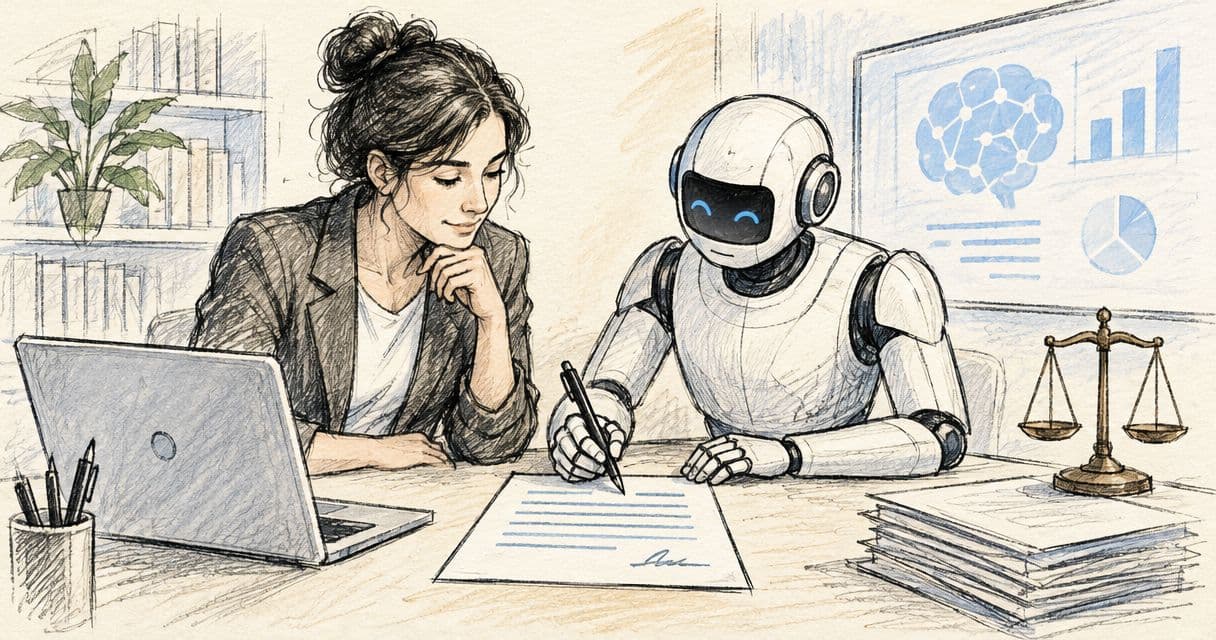
AI can produce a useful first draft of a legal contract, but it cannot establish that the agreement is legally correct, complete, or appropriate for your transaction. Accuracy depends on the instructions, source documents, applicable law, and review by a qualified lawyer—not on how polished the draft sounds.
Bizzy’s standard service covers front-office administration: inquiry follow-up, routine scheduling, and reminders from approved administrative details. It does not include access to financial or privileged documents, substantive legal drafting, or custom integrations. Any proposed work beyond that boundary needs a separately agreed scope, verified technical support, and an approved data-handling arrangement; a case study is not evidence that it is included for every customer.
- Can AI draft legal contracts accurately? It can assist with drafting; a qualified lawyer must assess legal accuracy.
- An approved contract template gives AI clearer drafting boundaries than an open-ended request.
- Check commercial terms, cross-references, definitions, and legal effect before signing.
- Substantive contract drafting is outside standard Bizzy administration; this checklist is for a lawyer-led drafting process.
Why this matters
A contract can read clearly and still allocate risk incorrectly. The dangerous mistake is treating fluent language as evidence that the agreement protects your interests.
For your 2026 drafting process, separate producing text from approving legal obligations. The first task is suitable for assistance; the second requires someone who understands the transaction and the governing law.
Bizzy provides an AI colleague for professional service teams, whose standard scope is administrative follow-up and scheduling, not substantive contract drafting. That makes the distinction practical: assistance with preparing a document is not confirmation that the document is ready to sign.
Can AI draft legal contracts accurately?
AI can help prepare contract text, but bounded instructions and human review do not guarantee legal accuracy. An AI-generated contract is not reliable merely because it follows a familiar format.
Accuracy has several parts. The draft must reflect the agreed deal, use consistent language, address relevant legal requirements, and produce the intended result when a dispute or exception occurs.
| Drafting approach | Best for | Main advantage | Main limitation |
|---|---|---|---|
| Approved template with AI assistance | Repeated agreements with defined changes | Starts from language your legal team has accepted | Changed facts can make template provisions unsuitable |
| AI draft from instructions | Preparing an initial document for lawyer review | Turns a written brief into organized contract language | Can omit necessary terms or add unsupported assumptions |
| Lawyer-led drafting with AI assistance | Transactions requiring legal judgment | Keeps responsibility for legal decisions with the lawyer | Still requires careful checking of generated language |
These approaches are not interchangeable. An approved template narrows the drafting task; it does not remove the need to assess whether the template fits this deal.
Nor does a second AI review establish correctness. Another generated answer is additional material to evaluate, not independent legal approval.
Drafting from an approved template
Best for: recurring agreements where the approved structure still fits the transaction. Give the drafting assistant the actual template and a clear list of authorized changes.
Specify which provisions must remain untouched. If the request concerns the contracting parties and scope of work, the draft should not quietly rewrite indemnification, limitation of liability, or termination rights.
The benefit is a defined starting point. The limitation is inherited error: an outdated or unsuitable template remains unsuitable even when the assistant fills it out neatly.
For a 2026 template review, ask the responsible lawyer to confirm suitability before treating the document as the drafting baseline. A familiar filename is not approval for a different jurisdiction, service, or customer relationship.
What should you give the drafting assistant?
Provide the approved source documents and distinguish settled terms from unresolved questions. Keep instructions concrete:
- Identify the legal parties and their roles.
- Describe the work or transaction being documented.
- State which commercial terms have been agreed.
- Identify provisions that must remain unchanged.
- Require unresolved facts to be flagged rather than supplied.
Ask for a separate list of changes and open questions alongside the draft. That list helps your reviewer find the assistant’s decisions, but it does not replace checking the document itself.
Drafting a new contract from instructions
Best for: preparing a working draft when no suitable approved template exists. The drafting brief needs to describe both the intended deal and the questions that remain open.
A broad request to write a services agreement leaves too much unspecified. It does not tell the assistant who owns the work, how acceptance operates, what happens when delivery slips, or which obligations survive termination.
The advantage is speed in organizing an initial document. The drawback is that the assistant can turn missing instructions into confident-looking provisions, leaving you to distinguish negotiated terms from generated assumptions.
Do not ask the assistant to make those decisions silently. Require an issues list before drafting, then have the responsible person resolve the commercial and legal questions.
For your 2026 process, treat a new AI-generated agreement as a working draft until review is complete. A complete-looking document can still contain unresolved decisions.
Why AI contract accuracy varies
The task you assign matters as much as the text you receive. These factors explain why a useful draft in one setting does not establish reliability in another:
- Source quality. An incorrect party name or conflicting term in the instructions can carry through into the agreement.
- Task boundaries. Updating a defined provision leaves fewer decisions open than drafting an entire agreement from a short prompt.
- Legal context. Governing law, transaction type, and the parties’ circumstances affect which terms are appropriate.
- Document dependencies. Changes to definitions, schedules, or amendments can alter provisions elsewhere in the agreement.
- Review quality. A grammar check does not examine enforceability, risk allocation, or whether the contract matches the agreed deal.
The drafting system does not resolve these issues merely by producing more text. Better instructions narrow uncertainty; qualified review addresses the decisions that remain.
How should you review an AI-drafted contract?
Use 2 separate review passes as a working discipline: first confirm the deal, then examine the document’s legal operation. This is a recommended process, not a measured accuracy guarantee.
Keep the agreed terms, source documents, and draft available together. Reviewing the draft in isolation makes it harder to identify a provision that sounds reasonable but contradicts the actual agreement.
1. Confirm the deal
Check the draft against the authorized commercial instructions. Verify the parties, scope, deliverables, payment obligations, deadlines, acceptance terms, and termination arrangements.
Pay attention to omissions as well as wrong statements. If the parties agreed on a handover obligation and the draft says nothing about it, polished wording elsewhere does not fix the gap.
2. Check the document
Read the agreement as a connected set of obligations. Verify defined terms, cross-references, schedules, notice provisions, and the relationship between the main agreement and any attachments.
Then examine what the language does. A change from a mandatory obligation to a discretionary permission can alter the deal without creating an obvious grammatical error.
3. Resolve open issues
Give each unresolved issue one of 3 review outcomes: accept, revise, or escalate. Record the decision and who has authority to make it.
Do not leave an assistant to choose the organization’s negotiating position. Questions about liability, ownership, confidentiality, or dispute resolution need an authorized decision-maker.
4. Approve release
Assign 1 named owner per agreement to confirm that required reviews are complete before the document goes out. Ownership prevents an internal working draft from being mistaken for an approved version.
Record which version received approval. If someone changes the agreement afterward, assess whether those changes require another review before signature.
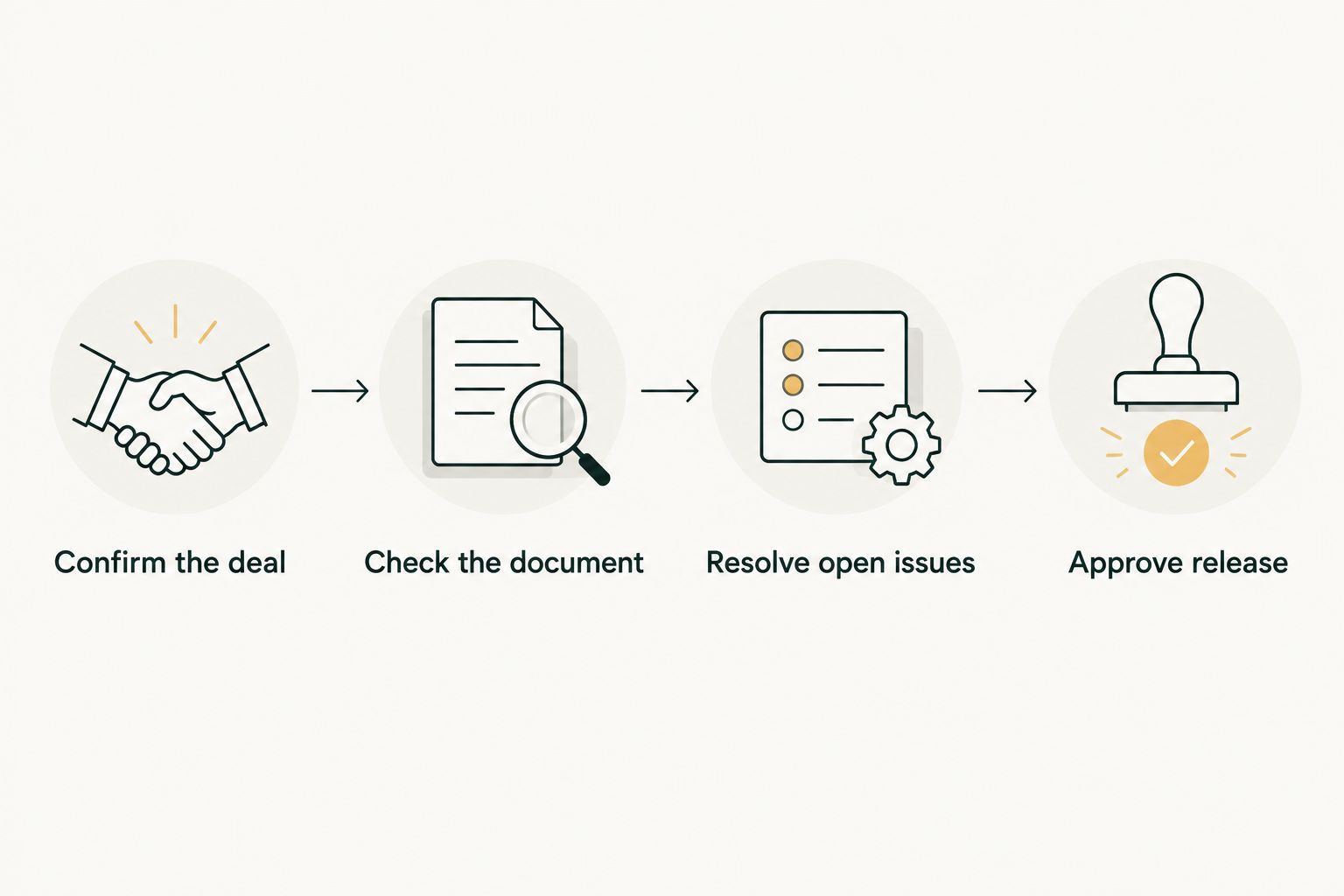
A review record should identify the document version, unresolved issues, decisions, and approval. It gives the next person something more useful than an assurance that someone checked it.
What contract mistakes should you look for first?
Start with provisions that determine who must do what, under which conditions, and with what consequences. Do not spend the entire review polishing language while those decisions remain unclear.
| Check | What can go wrong | What your reviewer should confirm |
|---|---|---|
| Parties and definitions | The wrong entity receives an obligation or right | Names, roles, and defined terms match the transaction |
| Scope and acceptance | Completion depends on an unclear standard | Deliverables and acceptance conditions reflect the deal |
| Ownership | The agreement assigns rights differently than intended | Ownership and permitted use match authorized instructions |
| Liability provisions | A limit conflicts with an exception elsewhere | The provisions work together as intended |
| Termination | Exit rights omit necessary consequences | Notice, outstanding duties, and surviving terms are addressed |
| References and attachments | A clause points to missing or incorrect material | Every reference reaches the intended provision or document |
Reading only the changed paragraph is not enough. A revised definition can affect obligations throughout the agreement, even when those other paragraphs remain untouched.
Can you put confidential client information into a drafting assistant?
Only use client information through a process that satisfies your professional duties and your organization’s requirements. Access to an account does not establish permission to upload a client’s documents.
Before sharing material, assess the provider’s terms, handling of submitted information, access controls, and relevant confidentiality obligations. Determine whether client communication or consent is required for the particular use.
Consult your jurisdiction’s professional rules and applicable guidance before using client material. A provider’s general description is not a confidentiality assessment, and a human approval step cannot undo an unauthorized disclosure.
For a 2026 policy, distinguish approved uses from prohibited uses and name the person who handles exceptions. Do not leave individual staff members to invent confidentiality rules while preparing a contract.
Where does an AI colleague fit in a legal team?
Bizzy’s standard service is front-office administration, not substantive legal drafting. A proposed custom drafting implementation would need a separate scope, verified technical support, approved data handling and qualified legal oversight; none is established by this article.
That role separates preparation from professional responsibility. Your team still needs to decide who supplies instructions, who resolves questions, and who approves a contract for use.
Do not assign confidential contracts to the standard administrative service. A separate implementation agreement and professional review would be prerequisites for considering such work, not guarantees of accuracy or suitability.
FAQ
Can AI draft a legally binding contract?
An AI-assisted contract can be legally binding if the applicable legal requirements are satisfied. Using AI neither establishes nor prevents enforceability; a qualified lawyer should assess the actual agreement and circumstances.
Do I still need a lawyer if AI writes the contract?
AI drafting does not replace a qualified lawyer’s assessment of legal accuracy and suitability. A lawyer can evaluate the agreement’s legal effect, unresolved risks, and fit with the transaction.
Is an approved template better than asking AI to start from scratch?
An approved template gives AI clearer drafting boundaries when the template fits the transaction. It still needs review because changed facts or unsuitable provisions can make the resulting agreement incorrect.
Can AI check a contract for mistakes?
AI can assist with checks such as inconsistent terms, missing information, and broken cross-references. Its findings require verification, and an absence of flagged issues is not legal approval.
Can I upload a client contract to any AI assistant?
Do not upload a client contract without confirming that the use satisfies confidentiality duties and organizational requirements. Assess the provider’s terms and information handling before sharing the document.
What should I check before signing an AI-drafted agreement?
Check that the agreement reflects the authorized deal and has received the required legal review. Verify the parties, obligations, definitions, attachments, risk provisions, and final approved version.
Does asking AI to review its own draft make it accurate?
A self-review does not establish legal accuracy. It can produce additional issues to investigate, but the draft still needs verification against source documents, instructions, and applicable law.
One last thing
For your 2026 drafting checklist, include a question that a spellcheck cannot answer: Which sentence changed an obligation? Ask the reviewer to identify changes to duties, rights, conditions, and exceptions—not just changes to wording.
An unchanged paragraph can acquire a different effect when a definition elsewhere changes. Read the final contract as a connected document, and keep release approval separate from the act of generating the draft.
Sources and scope
OpenAI’s capability overview describes drafting and rewriting as general AI assistance. It does not establish legal accuracy, enforceability, or suitability for a client contract. The checklist here is editorial process guidance, not legal advice or a verified Bizzy drafting feature.