Can AI write session notes for therapists?
By Leandro Faria · · Updated · 10 min read
Disclosure: Bizzy is built by 33Labs, the publisher of this guide.

Yes, AI can write draft session notes for therapists from information the therapist supplies, but the therapist must check the clinical content before signing or filing it. A usable draft does not establish that the service is appropriate for protected health information or that recording a session is permitted. Use AI to prepare documentation, not to make clinical judgments or finalize the record without review.
- Can AI write session notes for therapists? Yes—use AI-generated clinical documentation as a draft that requires therapist review.
- Check data handling, applicable agreements, recording rules, and clinical accuracy before using identifiable patient information.
- Bizzy fits professional-service workflow automation; that does not establish suitability for confidential therapy notes.
Can AI write session notes for therapists?
AI can turn therapist-supplied information into a structured draft, summarize an encounter, or organize material under an existing note template. Those are writing tasks. Deciding what happened clinically, what belongs in the record, and whether the note supports the treatment provided remains the therapist's job.
The input method changes what you need to review. Compare these approaches before choosing a documentation workflow in 2026.
| Approach | Best for | Main advantage | Main limitation |
|---|---|---|---|
| Drafting from therapist-written bullets | Clinicians who want control over the source material | Starts with information the clinician has already selected | Missing context stays missing unless the clinician adds it |
| Drafting from post-session dictation | Clinicians who prefer speaking their summary | Captures the clinician's account without recording the appointment | Dictation errors and omitted details can enter the draft |
| Drafting from a session recording or transcript | Practices that have approved session capture | Provides a detailed source to check against | Adds recording, consent, retention, and access questions |
| Writing the note manually | Encounters requiring close control over wording | Keeps drafting decisions directly with the clinician | Leaves the drafting work with the clinician |
Choose the least intrusive input that supports an accurate note. A full session recording is not a prerequisite for AI-assisted documentation.
Why this matters
A session note is part of care, not just an administrative summary. An incorrect statement about symptoms, an intervention, or a safety assessment can change how another clinician understands the encounter. Polished wording does not make that statement true.
Bizzy provides an AI colleague for professional-service workflows, including scheduling and document drafting. That scope is relevant to practice administration, but it is not evidence of clinical-note functionality or permission to process patient records. Keep those purchasing decisions separate.
For a therapy practice evaluating AI in 2026, the useful question is not whether a system can produce a readable paragraph. It is whether your practice can control the information entering the system, verify the result, and prevent an unchecked draft from becoming the official record.
How should you use AI to draft a session note?
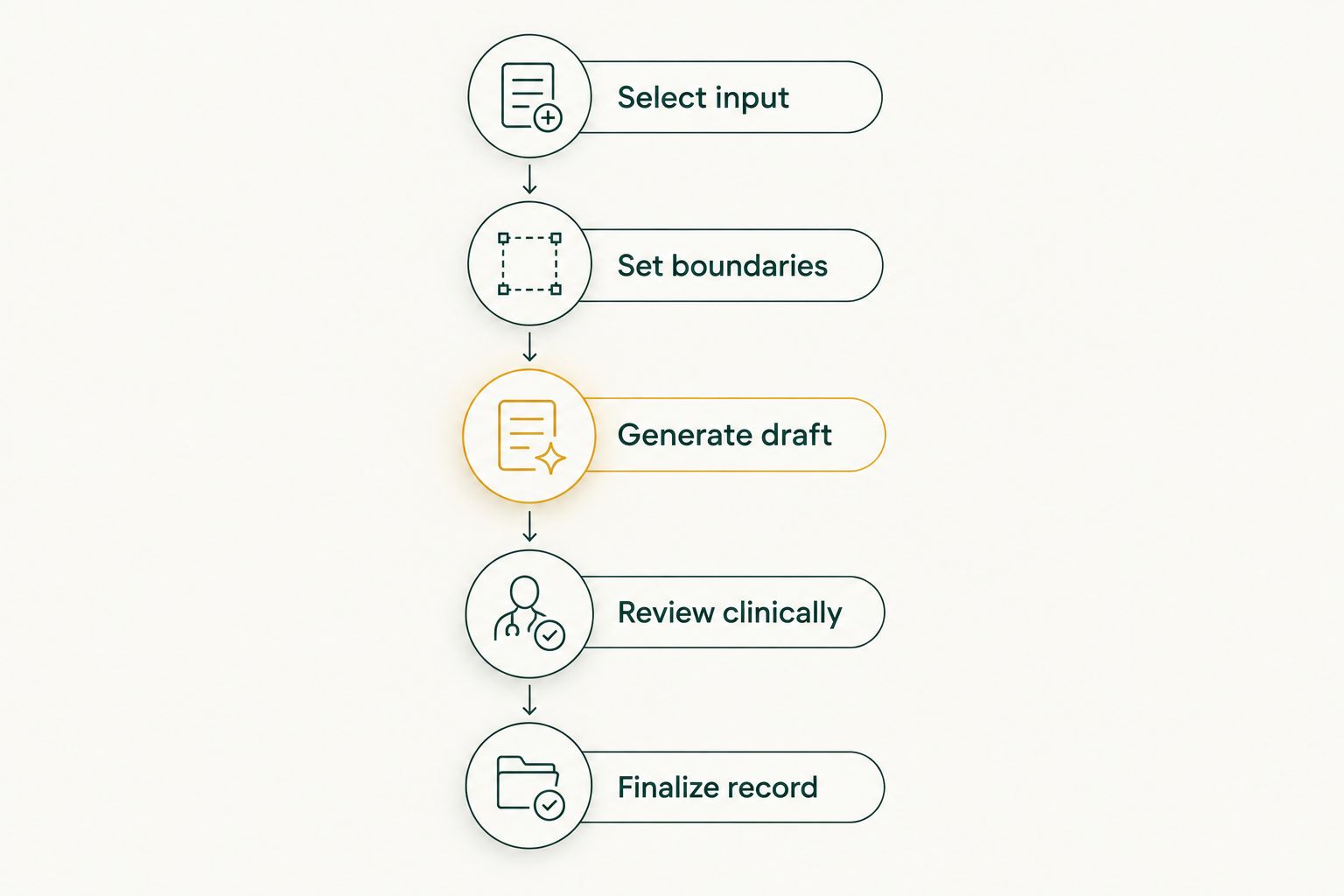
Build the process around a clinician-approved source and a review gate. The following sequence is a recommended workflow, not a claim about any particular vendor's capabilities.
Select input
Choose whether the source will be written bullets, post-session dictation, or an approved recording. Use only the information needed for the documentation task, consistent with your practice's privacy obligations and policies.
Keep information from different encounters separate. Prepare each draft for 1 session at a time so the source, client, and encounter date remain clear during review.
Set boundaries
Specify the note format and tell the system to use only the supplied facts. Require it to leave unsupported fields blank or flag them for clinician completion rather than fill them with plausible language.
A useful instruction is to distinguish client reports from clinician observations. A statement that a client reported poor sleep is not interchangeable with an observation made during the appointment.
Generate draft
Ask for a draft in the practice's established structure. Do not ask the system to make a sparse source sound more clinically complete by adding symptoms, interventions, diagnoses, or treatment responses.
Treat fluent language as presentation, not evidence. The draft still needs to be checked against the encounter and the source material.
Review clinically
Compare the draft with what you actually assessed, observed, and did. Correct misattributions, remove unsupported statements, and add necessary information yourself.
Give particular attention to negations and safety-related statements. Omitting a word such as “not” can reverse the meaning of a sentence.
Finalize record
Approve the corrected note through your established recordkeeping process. Keep draft handling, access, retention, and deletion aligned with practice policy and applicable obligations.
The handoff should be explicit: generation produces a draft; clinician approval produces the final documentation. Do not treat those events as interchangeable.
What should you check before signing an AI-generated note?
Use these 5 review checks per note as a starting checklist. They are review categories, not a substitute for your professional documentation standards.
- Identity and encounter: Confirm the correct client, encounter date, participants, and service details. Remove any content carried over from another encounter.
- Clinical facts: Verify symptoms, observations, interventions, and the client's response. Delete statements that were neither supplied nor established during the session.
- Attribution: Separate what the client said, what another person reported, and what you observed. Do not let a summary turn an allegation or impression into an established fact.
- Assessment and plan: Check that the documented assessment reflects your judgment. Confirm that follow-up actions and treatment changes match what you decided.
- Sensitive content: Remove unnecessary detail and check whether information belongs in the progress record or in separately maintained psychotherapy notes.
A note can pass a grammar check and fail every clinical check. Review meaning before style, and reject a draft when correcting it would be less reliable than writing the note yourself.
What makes AI note quality vary?
The quality of an AI-generated session note depends on the source and the instructions, not just the appearance of the output. These factors explain why the same drafting approach can produce a useful draft in one encounter and an unsuitable draft in another.
- Source completeness: The system cannot reliably document an intervention or assessment that the source does not describe. Missing information requires clinician input, not automatic completion.
- Speaker identification: A transcript must distinguish the therapist, client, and any other participants. Incorrect speaker attribution changes the meaning of the record.
- Template fit: The draft needs to follow the practice's documentation structure. A generic summary is not automatically a suitable clinical note.
- Language precision: Negation, uncertainty, and reported speech matter. Summarizing them loosely can create an inaccurate assertion.
- Encounter complexity: Conflicting accounts and sensitive disclosures require careful selection and wording. More source material does not remove that judgment.
- Review discipline: A required approval step gives the clinician a defined opportunity to catch errors. An unchecked draft lacks that safeguard.
For your 2026 evaluation, judge the corrected note and the work required to reach it. A fast first draft is not useful if it creates extra verification work or obscures important distinctions.
Are session notes the same as psychotherapy notes under HIPAA?
No. Under the HIPAA Privacy Rule definition in 45 CFR 164.501, psychotherapy notes have a specific meaning: notes recorded by a mental health professional documenting or analyzing counseling conversations and maintained separately from the rest of the medical record.
That definition excludes several items, including session start and stop times, treatment modalities and frequencies, and summaries of diagnosis, treatment plans, symptoms, prognosis, and progress. Ordinary progress documentation does not become specially protected psychotherapy notes simply because it concerns therapy.
This distinction matters when deciding what information enters a drafting service. Identify the record category before setting access or disclosure rules. Do not assume that a product's use of the phrase “therapy notes” resolves the legal classification.
What privacy checks belong in a 2026 evaluation?
Start with 3 safeguards before patient-data use: an appropriate contractual arrangement, documented data-handling rules, and controlled access. These are starting points, not a complete compliance determination.
Contractual arrangement
Determine whether the vendor will act as a business associate and whether a business associate agreement is required. HHS guidance on HIPAA and cloud computing explains that a cloud service provider handling electronic protected health information can be a business associate even when the information is encrypted and the provider lacks the decryption key.
A signed agreement does not settle every question. Your practice still needs to assess whether the service and proposed use meet its obligations.
Data handling
Get clear answers about storage, retention, deletion, subprocessors, and whether submitted content is used to train models. Check the service terms against the actual workflow rather than relying on a broad privacy statement.
Include the source material in this review. A recording, transcript, prompt, draft, and finalized note can create separate information-handling questions.
Controlled access
Define who can submit information, see drafts, approve notes, and retrieve stored material. Check how access is removed when staff roles change or someone leaves the practice.
Do not put identifiable patient information into an unapproved account while evaluating the service. Start with fictional examples that contain no real patient details.
Do you need consent to record therapy sessions for AI notes?
Recording requirements depend on applicable law and the circumstances of the session. State recording laws differ, and professional obligations and practice policies also affect how you explain and authorize session capture.
Before recording, establish what the client will be told about capture, processing, access, and retention. Address what happens if the client declines. Consent to recording and permission to disclose information to a service are related questions, not interchangeable answers.
You can also evaluate a workflow that drafts from clinician-written material instead of recording the appointment. That avoids session capture, but it does not eliminate privacy obligations when the material contains patient information.
How should a practice evaluate a service in 2026?
Define the intended job before reviewing vendors: draft a note from approved source material, preserve factual distinctions, and stop for clinician approval. Then assess the service against that job.
Use fictional cases containing missing information, ambiguous speakers, and explicit negations. Check whether the output preserves those limits or replaces them with confident assertions. Also inspect what happens to the source and draft after the task ends.
Ask the vendor to demonstrate the proposed workflow rather than infer clinical suitability from a general document-writing feature. Bizzy's stated work includes drafting documents and automating internal workflows; those capabilities alone do not establish support for therapy documentation, recording consent, or HIPAA requirements.
Choose a clinical documentation workflow only after its privacy arrangements and review controls meet your practice's requirements. Keep administrative automation and clinical-record approval as separate evaluation tracks.
FAQ
Can AI write session notes for therapists without recording the session?
Yes, AI can draft session notes from therapist-written bullets or post-session dictation without recording the appointment. The therapist still needs to verify the draft and use an appropriate service for any patient information involved.
Can I put client details into any AI chatbot?
No—do not enter identifiable client information into an unapproved AI chatbot. Assess the proposed use, applicable privacy obligations, contractual arrangements, and data handling before submitting patient information.
Does a business associate agreement make an AI note service HIPAA compliant?
A business associate agreement alone does not establish that your use of an AI note service meets HIPAA requirements. The service configuration, safeguards, policies, and actual information handling also matter.
Can AI decide what diagnosis belongs in a session note?
AI-generated text is not a substitute for the therapist's diagnostic judgment. The draft should reflect the clinician's established assessment rather than introduce an unsupported diagnosis.
Are AI-generated progress notes automatically psychotherapy notes?
No, AI-generated progress notes are not automatically psychotherapy notes under HIPAA. The definition depends on the content and separate maintenance of the notes, not whether AI helped write them.
Can Bizzy write confidential therapy notes?
Bizzy's stated capabilities include document drafting for professional-service workflows, but that does not establish suitability for confidential therapy notes. Verify the clinical workflow, privacy arrangements, and approval controls before considering that use.
What's the safest way to test an AI note-writing workflow?
Start with fictional cases containing no real patient information. Check factual accuracy, handling of missing details, access controls, and the clinician approval step before considering a patient-data workflow.
One last thing
For a 2026 pilot, test whether the system knows when to leave something unwritten. Give it a fictional source that omits a risk assessment, then check whether the draft invents one.
A visible gap is better than a fabricated clinical statement. Your process should bring that gap to the therapist for completion—not hide it beneath polished prose.